I Started Learning AI. I Didn't Expect It to Change How I See the Software Industry.
A reflection on the value spectrum of IT - from commodity code to enterprise solutions - and why AI is shifting the center of gravity toward architecture, systems, and outcomes.
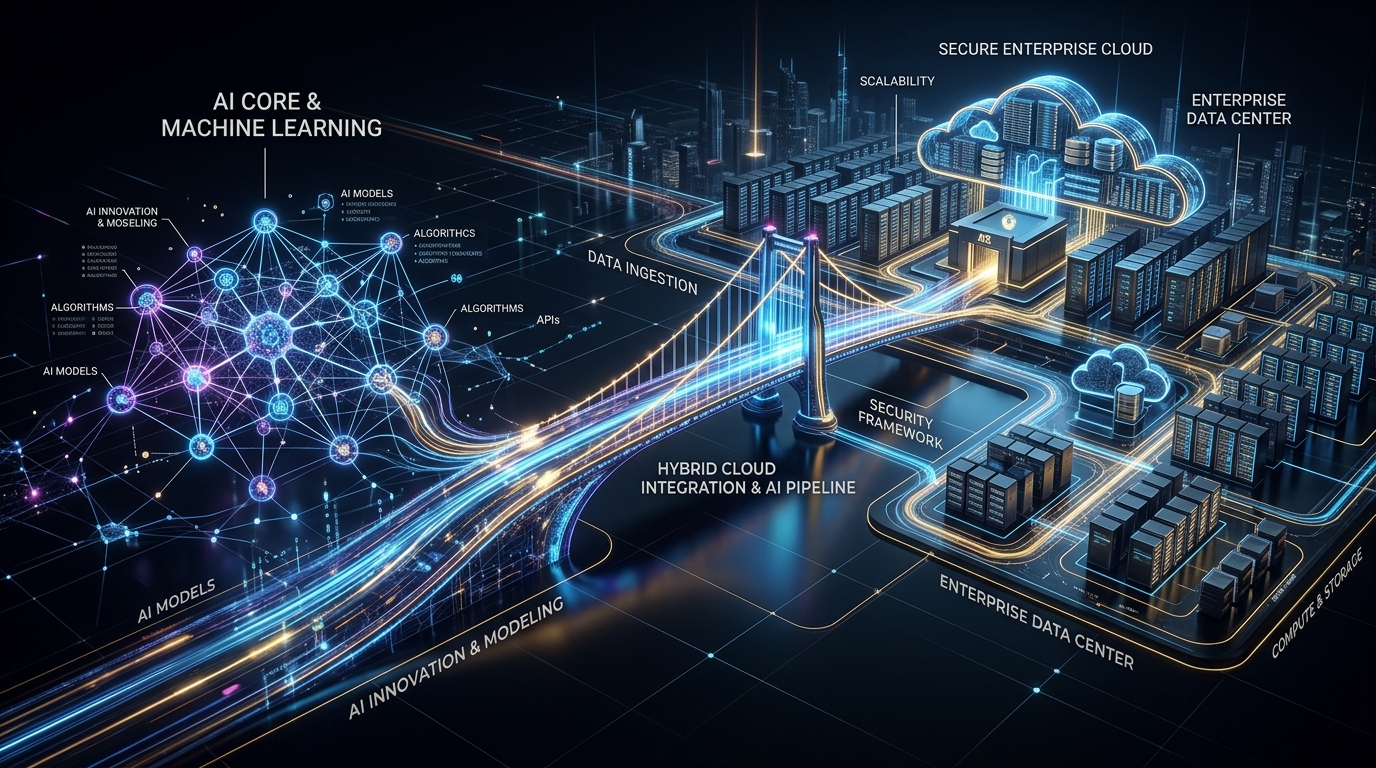
When I first enrolled in AIO 2026, my goal was purely technical: master the math and train models from scratch. But diving into AI made me see the software industry through a completely new lens - understanding why selling developer hours is being commoditized and where true value is moving.
The Illusion of Pure Engineering
When I first enrolled in the AIO 2026 program, my goal was purely technical. I wanted to understand the mathematical mechanics behind Transformers, how multi-head self-attention computes context vectors, and how to train neural networks from first principles.
Coming from a traditional software engineering background - where I spent my days designing backend APIs in Java/Spring and managing relational databases - I held a classic developer dogma: "The closer you operate to the raw silicon, matrix math, and loss gradients, the higher your engineering value." In my mind, classical ML and custom PyTorch kernels represented the mythical, elite tier of computer science. Anything higher up the stack felt like ordinary business glue.
However, as I started building practical AI systems and analyzing how artificial intelligence actually creates impact in the real world, a conversation with an industry mentor completely shifted my mental model:
“Building the neural network is not the same as building the solution. The most mathematically beautiful model in the world provides exactly zero business value if it isn't integrated into a secure, scalable enterprise architecture.”
That statement forced me to step back from the terminal and examine the broader software industry through a completely different lens.
Deconstructing the IT Services Spectrum
To understand where engineering value actually lives, we have to deconstruct how the global technology services industry is organized. It isn't a simplistic binary of "Companies need code $\rightarrow$ Outsourcing vendors supply coders." It is a continuous spectrum of value creation:
Strategy Consulting
McKinsey • BCG • Bain
“What should the business do?”
- Corporate & market strategy
- Capital allocation
- Operating models
- Organizational transformation
Technology Consulting
Accenture • Capgemini • IBM • Big 4
“How should technology be architected to solve the business problem?”
- End-to-end solution design
- Cloud & enterprise architecture
- AI & Data engineering systems
- Full production implementation
Traditional IT Outsourcing
Capacity-Based Staff Augmentation
“How many developer hours do you need?”
- Billable engineering capacity
- Ticket-based coding assignments
- Headcount provisioning
- Direct labor arbitrage
Historically, the boundaries between these tiers were distinct. But today, the lines are blurring. MBB firms are establishing internal technology units, while ITO providers strive to move upmarket into consulting. The critical differentiator is not what firms call themselves - it is where in the value chain they create and capture value.
The Economic Shockwave: How AI Commoditizes Raw Hours
This is where artificial intelligence becomes an economic catalyst.
The traditional IT outsourcing model is mathematically tethered to developer headcount:
However, modern AI tooling acts as an exponential productivity multiplier. From writing boilerplate scaffolding and generating unit tests to debugging SQL queries and automating refactoring, AI dramatically compresses the time required to produce code.
This does not mean software engineers will disappear. It means that raw, undifferentiated coding labor is being commoditized. If a developer assisted by AI can produce in 2 hours what previously took 10 hours, a business model that sells hours faces structural deflation.
Conversely, companies like Accenture and modern technology consulting practices operate under a fundamentally different value proposition:
“Instead of selling 500 developer hours, we sell the end-to-end technology solution that unlocks business transformation.”
For outcome-oriented firms, AI is not a revenue threat - it is a delivery accelerator. It enables them to design, build, test, and deploy complex systems faster and at higher margins, while continuing to capture value from the solution architecture rather than the time spent typing.
In this new reality, economic value shifts decisively toward:
Connecting the Micro to the Macro
In my previous blog post on AI Engineering, I explored the Micro / Systems level: demonstrating why agent runtimes, dynamic semantic control flow, and deterministic state management are where real systems engineering lives.
This essay is the Macro / Enterprise counterpart.
When an enterprise adopts Generative AI, they do not just need a chatbot in a standalone browser window. They require an integrated architecture that bridges three foundational tiers:
The AI Layer (Modeling & Intelligence)
Grounding models in foundational mathematics (Transformers, embeddings, vector indexing, fine-tuning, and semantic evaluation).
The Application Layer (Software Engineering Discipline)
Designing type-safe REST APIs, microservices, background job workers, and database schemas using Java, Python, and SQL.
The Cloud & Governance Layer (Enterprise Infrastructure)
Provisioning scalable cloud compute (Azure), identity and access management (IAM), data lake security, telemetry, and automated MLOps.
A machine learning model without an application wrapper is just an academic experiment. An application without secure enterprise cloud infrastructure is a corporate liability. True business impact happens exclusively at the intersection of all three.
My Trajectory: The Deliberate Bridge
This realization transformed how I view my own background.
My years in software engineering - building Java/Spring APIs, managing database migrations, and architecting backend services - weren't a detour from AI. They were the essential foundation. They gave me the discipline to understand latency, concurrency, schema integrity, and state management.
Rather than trying to leap prematurely to high-level consulting titles, I am executing a deliberate, multi-stage engineering roadmap:
STRATEGIC_TRAJECTORY // CAREER_ROADMAP
  [ CURRENT BASE ]                [ IMMEDIATE IDENTITY ]                [ LONG-TERM VISION ]
  Software Engineer      ───▶          AI Engineer             ───▶     AI Solution Architect
  (Java, APIs, DBs)             (AIO 2026 + Production AI)              (Cloud, Enterprise & Systems)
Backend architecture, clean API contracts, database persistence, and high-throughput reliability.
Broad AI/ML depth: Classical ML, Deep Learning, CV, NLP, Transformers, and type-safe agent runtimes.
Mastering Azure cloud architecture, enterprise governance, and scalable end-to-end AI integration.
I am building myself into an engineer who can sit across the entire value chain: someone who understands the business problem, architects the cloud infrastructure, comprehends the deep learning mechanics under the hood, and writes the production code that brings the system to life.
This isn't the end of my learning journey. It is the moment where I finally understand exactly where the journey is going.