The Detective vs. The Blacksmith: Demystifying Data Science vs. Artificial Intelligence
Why Data Science welcomes diverse professions to investigate domain mysteries horizontally, while Artificial Intelligence demands core CS/IT engineering to forge the machine vertically.
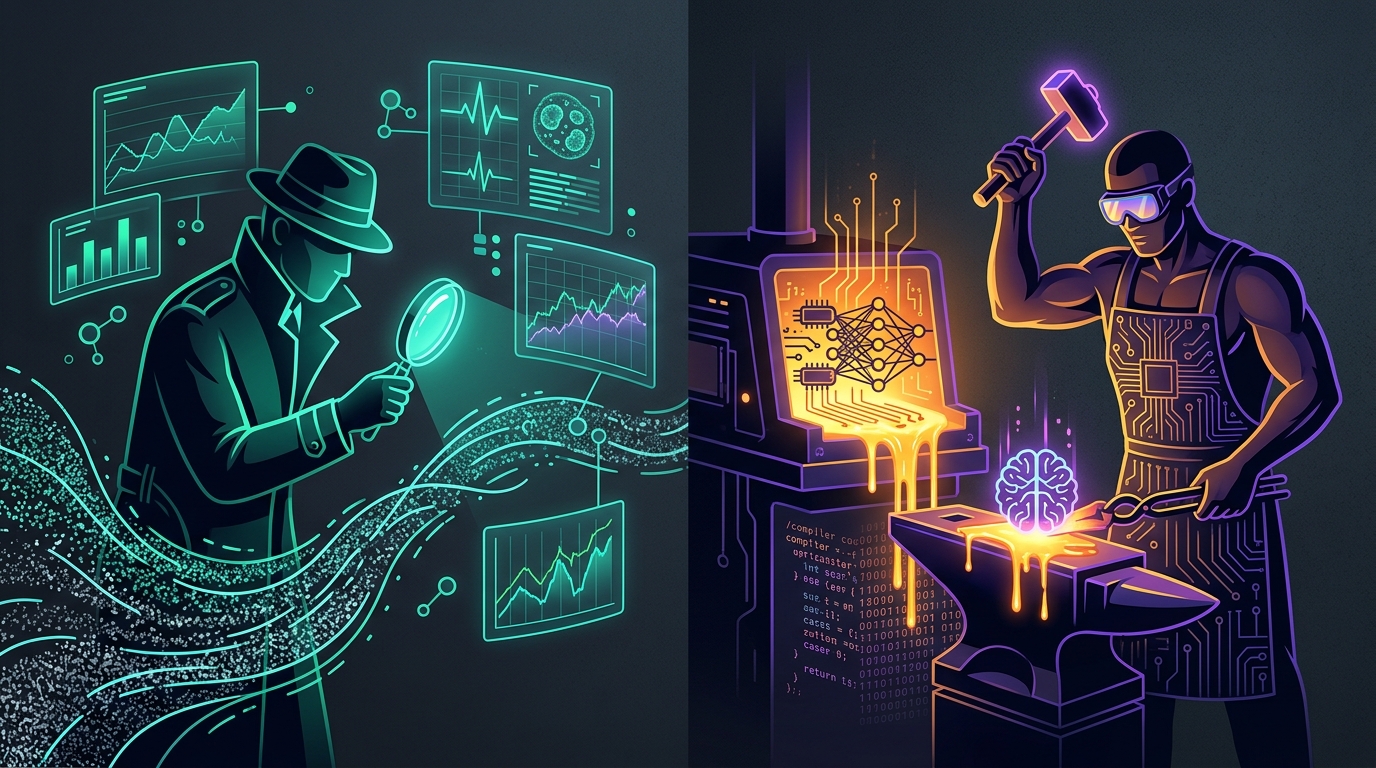
Ever notice how Data Science job postings welcome economists and biologists, while AI roles demand deep CS/IT engineering foundations? It is not arbitrary HR gatekeeping. They represent two perpendicular axes of technical intellect: The Detective vs. The Blacksmith.
The "It's All Just Coding" Illusion
In our current era of multi-trillion-parameter foundation models, autonomous agents, and Big Data dashboards, the perimeter between technical disciplines has effectively dissolved in the public imagination.
To an outside observer - a non-technical executive, a recruiter scanning LinkedIn keywords, or a curious parent - everyone working in technology looks functionally identical: someone sitting in front of a dark IDE, tapping away at obscure syntax, watching console logs stream past, and pushing commits to GitHub.
Because everyone uses a computer and everyone writes code, society treats technical careers as a single, homogenous blob called "Tech." If you know Python, you are assumed to be an AI practitioner. If you write SQL queries, you are labeled a Data Scientist. If you configure a cloud server, you are expected to train a neural network.
“Conflating Data Science with Artificial Intelligence is like confusing a cardiologist with an aerospace mechanical engineer simply because both work with valves, pumps, and fluid dynamics.”
You can observe this fundamental divergence the moment you read real-world Job Descriptions (JDs):
When choosing a degree, selecting advanced coursework, or making high-stakes career decisions, treating these fields as interchangeable is a devastating intellectual trap. You end up deeply frustrated:
These disciplines do not exist on a single linear hierarchy of difficulty or prestige. They represent two entirely perpendicular directions of human intellect:
- Horizontal Application (Data Science): Thinking in width. Borrowing data from external domains to investigate, explain, and optimize real-world human and physical phenomena.
- Vertical Core Engineering (Artificial Intelligence): Thinking in depth. Grounded in Computer Science and IT infrastructure to forge, optimize, and scale the computational engine itself.
Data Science (DS): The "Horizontal" Detective
At its core, Data Science sits at the precise tri-junction of Mathematics & Statistics, Computational Tooling, and Domain Knowledge.
Notice the critical meta-reality that separates Data Science from pure computing: Data Science does not own the data; it borrows it.
Data does not spontaneously generate inside a computer science lab. Data belongs to oncology wards (histopathology scans and patient vitals), commercial banks (credit card authorization logs and loan defaults), maritime logistics networks (AIS container telemetry), or e-commerce platforms (clickstreams and abandonment rates). Without an external host industry, Data Science has no native subject matter.
“A data scientist is not a machine builder; they are a detective. They pick up established magnifying glasses - statistical inference, regression curves, survival models, XGBoost, clustering - and step into another industry's messy crime scene to solve an urgent mystery.”
Consider the nature of the questions a Data Scientist actually answers in the wild:
“Which genomic alterations and patient co-morbidities correlate with resistance to targeted immunotherapy in triple-negative breast cancer?”
“How can we distinguish legitimate cross-border remittances from multi-hop smurfing rings designed to evade anti-money-laundering filters?”
“At what weather threshold and port congestion index do vessel reroutings yield lower demurrage penalties than waiting at anchor?”
“Why did user retention decline 18% among cohort B after the onboarding UI redesign, and is the effect confounded by platform acquisition channel?”
Why Data Science Welcomes Non-CS Majors
This horizontal nature explains why Data Science has always been extraordinarily hospitable to economists, physicists, molecular biologists, psychologists, and epidemiologists.
In Data Science, domain intuition represents at least 50% of your effectiveness. A medical doctor who learns Python, SQL, and causal inference will routinely extract more clinically actionable, nuanced discoveries from electronic health records than a brilliant software engineer who doesn't know the difference between creatinine levels and troponin markers.
Understanding industry mechanics, regulatory constraints, business drivers, and human behavior.
Hypothesis testing, bias correction, confounding variable isolation, and causal modeling.
Python/R, pandas, scikit-learn, SQL, visualization dashboards, and pipeline orchestration.
# Solving the mystery: Is churn caused by pricing or app latency?
import statsmodels.formula.api as smf
model = smf.logit("churn ~ p95_latency_ms + C(plan_tier) + account_age_months", data=df).fit()
# Testing for confounding causal interaction
odds_ratio = np.exp(model.params['p95_latency_ms'])
print(f"Crime Solved: Every 100ms latency increase elevates churn odds by {(odds_ratio - 1) * 100:.1f}%")
Artificial Intelligence (AI): The "Vertical" Blacksmith
Now step across the threshold into the workshop of the Blacksmith.
While Data Science acts as the Detective borrowing data to investigate outside industries, Artificial Intelligence is the Blacksmith. This is where technology studies, improves, and reinvents technology itself. AI researchers and machine learning engineers do not require an outside industry's problem to justify their existence. Their laboratory is the machine itself.
And here is the critical distinction: an AI practitioner cannot forge anything without standing firmly on Computer Science and Information Technology.
“Artificial Intelligence is the blacksmith at the forge, using the anvil of Computer Science and the infrastructure of IT to hammer out a lighter, faster, sharper, and more capable cognitive engine. Downstream, whether that engine powers medical diagnostics or financial security is an application detail. The AI engineer's passion is the metallurgy of machine intelligence.”
To build real AI, you must orchestrate three foundational layers of the computing stack:
The Brain Designer
Artificial Intelligence & Deep Learning
“How do we make the model reason and converge faster with less compute?”
- Linear attention architectures ($O(N)$ vs $O(N^2)$)
- KV-cache memory compression
- Post-training alignment (DPO, PPO, GRPO)
- Weight quantization (FP16 $\rightarrow$ INT4)
- Representation learning & embeddings
The Master Architect
Computer Science & Systems Engineering
“How do we structure computation to extract theoretical limits from silicon?”
- Compilers & intermediate representations (LLVM)
- Distributed consensus protocols (Raft, Paxos)
- Memory hierarchies & cache line coherence
- Time & space algorithmic complexity
- Operating system kernels & memory barriers
The Fortress & Highway Builder
Information Technology & Cloud Infrastructure
“How do we ensure global systems remain secure, fault-tolerant, and low-latency?”
- Multi-region cloud backbones (AWS/Azure)
- Zero-trust networking & post-quantum crypto
- Kubernetes orchestration & service meshes
- High-throughput distributed streaming (Kafka)
- Site Reliability Engineering (SRE) & telemetry
// Forging the engine: Fused FlashAttention CUDA kernel
__global__ void flash_attn_kernel(const half* __restrict__ Q, ...){
    // Tiling shared memory to bypass slow GPU HBM bandwidth
    __shared__ half s_Q[TILE_SIZE][HEAD_DIM];
    __shared__ half s_K[TILE_SIZE][HEAD_DIM];
    __syncthreads(); // Hardware-level warp synchronization
}
The Core Architectural Matrix: Detective vs. Blacksmith
To bring total clarity to this distinction, let's lay out the two paradigms side-by-side across their fundamental operating dimensions:
| Dimension | Data Science (The Detective) | Artificial Intelligence (The Blacksmith) |
|---|---|---|
| Vector of Intellect | Horizontal (Cross-Domain): Applied inquiry. Exploring external industries (medicine, retail, finance). | Vertical (Inward/Upward): Core engineering. Pushing the boundary of models, algorithms, and infrastructure. |
| Primary Question | “What does this data tell us about the real world, and what decision should we make?” | “How do we make the machine faster, smaller, more reliable, and mathematically sound?” |
| Core Dependency | Deeply dependent on Domain Context. (Data is meaningless without understanding where it was born). | Deeply dependent on Computing Foundations. (Data structures, linear algebra, memory models, protocols). |
| Raw Material | Messy, biased real-world observations: hospital scans, credit logs, user clickstreams, survey responses. | Silicon primitives: GPU memory buffers, CPU registers, matrix tensors, network packets, compiler ASTs. |
| Fatal Failure Mode | P-hacking, survivorship bias, confusing correlation with causation, providing statistically correct answers to the wrong business problem. | Race conditions, memory leaks, gradient explosion, network partitioning, premature optimization of useless code. |
| Metric of Success | Decision quality, business ROI, reduced mortality rates, increased operational efficiency. | FLOPS efficiency, inference latency (p99), system uptime (99.999%), throughput, memory footprint. |
| Ideal Temperament | The Skeptical Investigator: curious about human behavior, comfortable with ambiguity, loves storytelling with evidence. | The Precision Craftsman: obsessed with elegance, hardware physics, deterministic correctness, and system performance. |
The Symbiosis: Why Neither Survives Alone
It is tempting for technologists to declare one side superior. Software engineers often dismiss data analysts as "just running SQL queries," while data scientists sometimes mock backend developers as "plumbers who don't understand statistics."
Both attitudes are fundamentally myopic. Neither discipline can survive in isolation:
A blacksmith without detectives creates astonishingly fast engines that solve zero human needs. You spend two years training an ultra-efficient 100M-parameter language model with custom Triton kernels, only to realize the enterprise doesn't need a custom model - they needed a deterministic SQL rule engine with clean data governance.
A detective without blacksmiths is left trying to investigate modern cybercrimes with a 19th-century magnifying glass. You formulate a brilliant statistical hypothesis to detect ICU sepsis, but your Jupyter Notebook runs out of RAM on 50,000 patient records because you have no understanding of streaming I/O or vector index pagination.
I have witnessed this symbiosis firsthand while preparing for the Ho Chi Minh City AI Challenge (HCMC AIC) and building agentic systems.
When you construct a competitive multi-modal retrieval system across thousands of hours of video keyframes:
- You need the Blacksmith to architect asynchronous tensor ingestion queues, write low-latency vector similarity search bindings, and manage GPU memory pools under extreme concurrency.
- You need the Detective to inspect retrieval failure modes, analyze semantic query drift, understand visual ambiguity across video frames, and design post-filtering re-ranking heuristics.
High-performance production AI is not a choice between the forge and the crime scene. It is the art of using the forged engine to crack the case.
Strategic Clarity: Choosing Your Weapon
If you are at a crossroads - deciding on a degree, selecting an online specialization, or pivoting your software engineering career - stop asking which field pays 5% more or which job title sounds cooler on Twitter.
Ask yourself a fundamental question about what sparks your intellectual curiosity:
“Are you in love with the phenomenon, or are you in love with the machine?”
STRATEGIC_FRAMEWORK // CHOOSING_YOUR_TOOLKIT
- You love the real world: economics, medicine, biology, sociology, finance.
- You get excited by uncovering patterns and explaining the "why" behind human decisions.
- You enjoy translating messy, imperfect data into crisp strategic decisions for stakeholders.
- You want a career where your domain intuition is as valuable as your code.
- You love the mechanics of computing: algorithms, systems, compilers, networks.
- You get excited by raw performance: latency reduction, FLOPS, memory efficiency.
- You want to build the platforms, frameworks, and engines that other developers build on.
- You want to advance the fundamental boundaries of artificial intelligence.
As for me, my background in backend software engineering taught me to respect the discipline of the blacksmith - designing type-safe APIs, managing transaction integrity, and keeping servers running under load.
Yet as I dive deeper into machine learning and complex AI architectures, I have come to appreciate the instincts of the detective. The greatest engineers of the next decade will not be dogmatic purists locked in one corner of the forge or the crime scene. They will be the hybrid builders: engineers who possess the technical discipline to forge resilient systems, and the investigative intuition to solve problems that actually matter to humanity.
The blacksmiths build the sword. The detectives solve the mystery. Choose your craft with clarity - and master it with pride.